Augustus Raises $180m to Build a Chartered Dollar Clearing Bank for Stablecoins
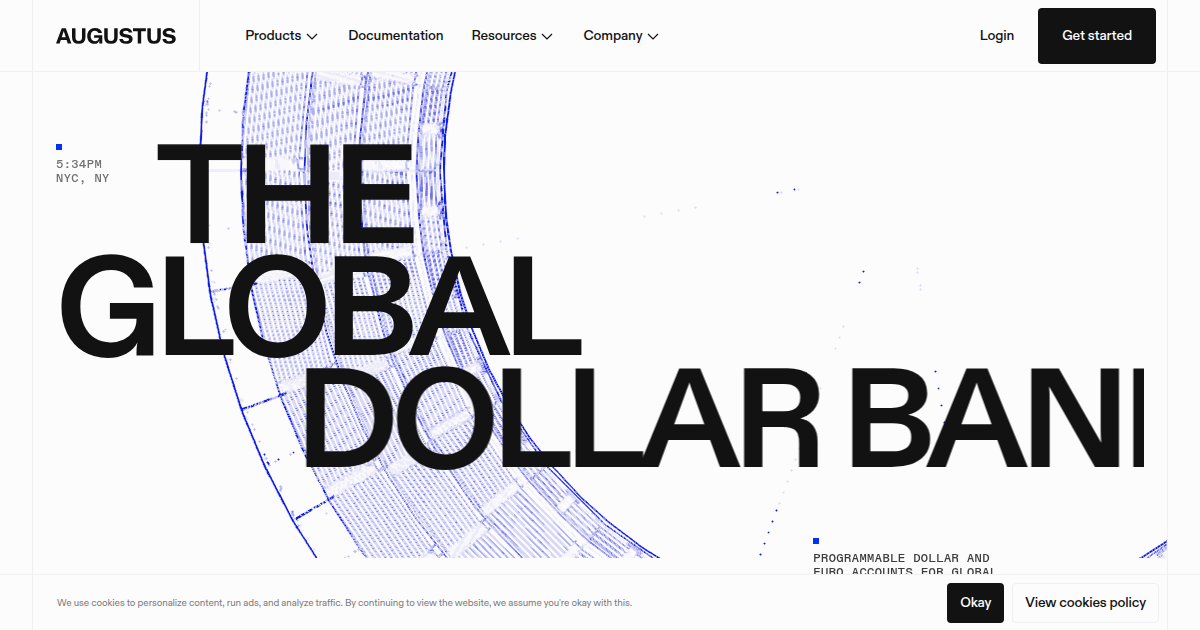
Augustus, the correspondent banking startup formerly known as Ivy, has raised $180m in a Series B round to build out a platform giving financial institutions direct access to US dollar accounts and rails through a federally chartered bank. The company announced the round on 21 July, with QED Investors among the participants.
The money is earmarked for serving FinTechs and banks in Latin America, Southeast Asia, the Middle East and Africa, the four regions where access to dollar clearing is most constrained and most expensive. Augustus's platform supports operating and FBO accounts with named virtual accounts, and lets customers transact with first and third parties across Swift, ACH, SEPA and stablecoins.
"We started Augustus with a simple thesis: the Dollar is the greatest product in the world but its distribution is fundamentally broken," said Ferdinand Dabitz, co-founder and chief executive of Augustus. "This financing lets us execute on our mission to provide high-quality dollar access to international FinTechs and banks. It's time to dollarize the world."
The target here is correspondent banking, and it is a genuinely underattacked part of the stack. Nigel Morris, managing partner at QED Investors, made the point directly: correspondent banking has not yet been challenged by FinTechs, leaving global FinTechs and banks with a choice between "slow, low-tech" incumbent correspondent banks and middleware providers that sit on top of someone else's licence. "Augustus solves this by combining cutting-edge technology with a real bank charter, providing international financial institutions with a modern, direct dollar clearing platform," Morris said.
That phrase, a real bank charter, is the whole proposition. Ivy rebranded as Augustus on 11 May and announced on the same day that it had received conditional approval from the Office of the Comptroller of the Currency to establish a full-service US national bank. The distinction between holding a charter and renting access to one is the difference between being a clearing participant and being a customer of a clearing participant. Middleware providers can move money quickly, but they cannot insulate their clients from the correspondent's de-risking decisions, account closures or compliance appetite, because they are subject to the same decisions themselves.
De-risking is the structural context that makes this fundable. The withdrawal of large Western correspondent banks from emerging-market relationships over the past decade, driven by the cost of AML compliance relative to the revenue on those corridors, has left banks and FinTechs across Africa, Latin America and parts of Asia struggling to maintain reliable dollar access. The vacated corridors did not become less economically necessary; they simply became harder and dearer to serve. A chartered entrant that has priced compliance into its model from the outset is attacking a market defined by incumbent withdrawal rather than incumbent complacency.
The stablecoin element is what differentiates the pitch from a straightforward challenger correspondent bank. Augustus has said its goal is to become the first clearing bank "for the AI era", built on a stablecoin and AI-native core, and its rails list places stablecoins alongside Swift, ACH and SEPA rather than in a separate crypto compartment. The practical argument is that dollar-denominated stablecoins already function as a de facto settlement layer in exactly the markets where correspondent access is weakest, and that a chartered bank able to bridge between tokenised and conventional dollars can intermediate that flow inside the regulatory perimeter rather than around it.
For incumbent correspondent banks, the competitive question is whether the relationships they have retained are ones they actively want. The corridors Augustus is targeting are largely the ones the large clearers have spent a decade exiting, which means the near-term contest is for business the incumbents have already decided is not worth the compliance overhead. The longer-term risk is different: if a chartered, stablecoin-native clearer can service those corridors profitably, it establishes both that the compliance cost was a technology problem rather than a structural one, and that a new entrant can build primary dollar relationships with institutions that will eventually want more than clearing.