DBS Rolls Out Blockchain-Powered Banking for Institutions
Singapore's DBS Bank has introduced a new suite of blockchain-powered banking services that enables institutional clients to execute real-time,...
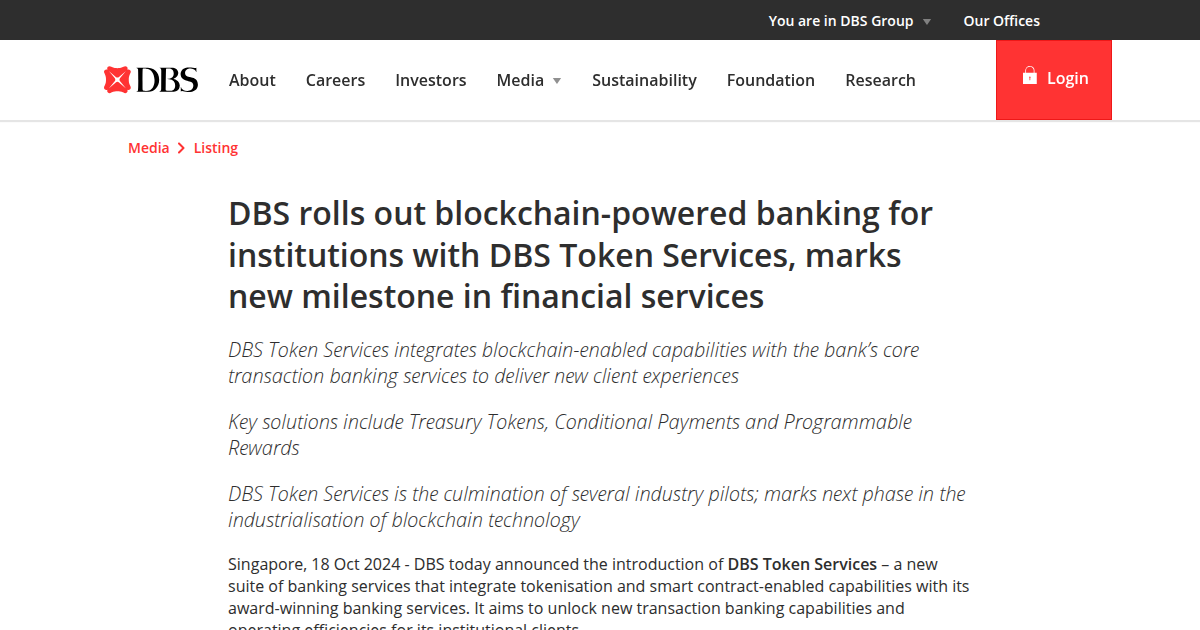
Singapore's DBS Bank has introduced a new suite of blockchain-powered banking services that enables institutional clients to execute real-time, around-the-clock payment settlements using a permissioned blockchain.
The platform integrates tokenisation and smart contract technology into DBS's institutional banking infrastructure, allowing corporate clients to programme payment conditions, automate settlement workflows, and access 24/7 liquidity management capabilities. Transactions are processed on a permissioned blockchain controlled by DBS, ensuring regulatory compliance and transaction privacy.
The service addresses longstanding limitations of traditional banking infrastructure, where payment processing and settlement are constrained by banking hours, batch processing cycles, and correspondent banking intermediaries. By moving these functions onto a blockchain, DBS can offer continuous settlement with programmable conditions that execute automatically when predefined criteria are met.
DBS has been among the most active global banks in developing blockchain-based financial services, having launched its own digital asset exchange and participated in multiple tokenisation initiatives. The new institutional banking services extend these capabilities from digital assets into mainstream corporate banking operations.
The platform supports multi-currency settlement and can be integrated with clients' existing treasury management systems through APIs. DBS said the programmable payment capabilities are particularly suited to supply chain finance, trade settlement, and cross-border corporate treasury operations where conditional payments are common.
The launch positions DBS as one of the first major banks to offer production-grade, blockchain-native banking services to institutional clients rather than treating blockchain as an experimental technology.