Backbase Unveils AI-Native Banking OS in 'Category Creation' Bid for Agentic Banking
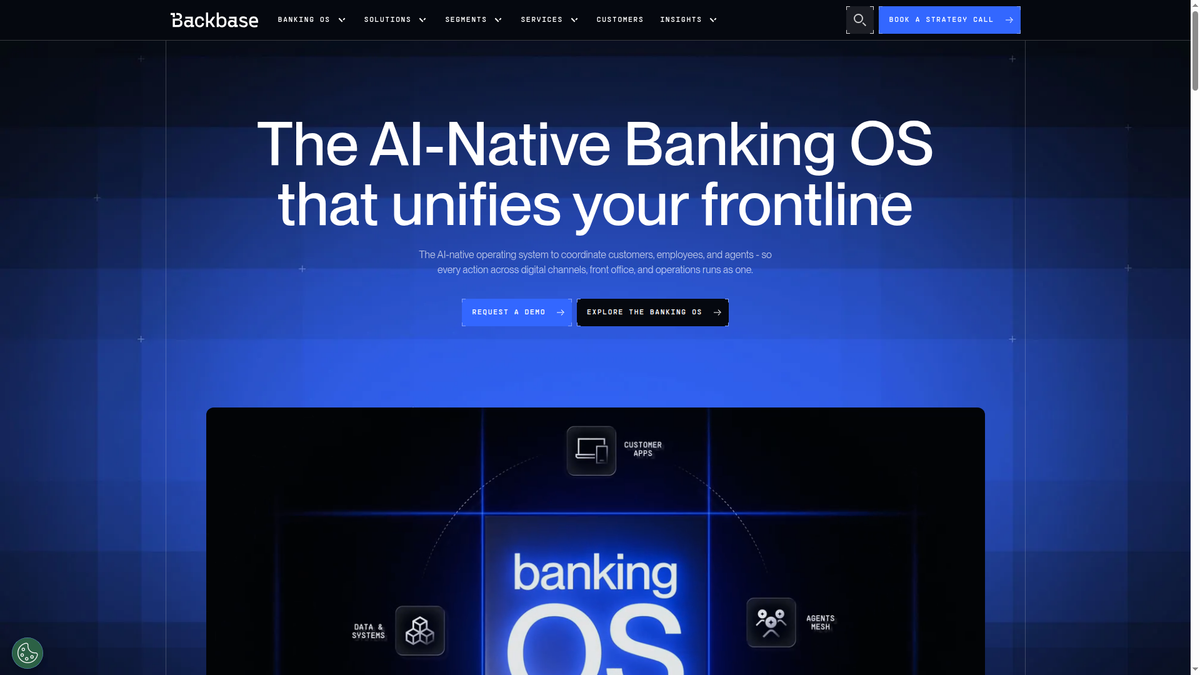
Backbase has used its ENGAGE Americas conference in Nashville to launch what it calls the AI-Native Banking OS, an announcement chief executive and founder Jouk Pleiter described as the company's most significant in its 22-year history and a deliberate attempt at category creation in banking technology.
The Amsterdam-headquartered vendor is positioning the new platform as the operating layer for what it terms a "Unified Frontline" - a model in which customers, bank employees and AI agents work from a single set of context, controls and execution rails across digital channels, the front office and operations.
The pitch leans hard on a structural argument about why agentic AI is stalling inside banks. Drawing on its more than 120 deployments, Backbase estimates that roughly 80 per cent of frontline banking work happens in the whitespace between systems - the handoffs, coordination and exceptions that no single application owns. That, the company argues, is precisely the work banks now want to hand to AI agents, and precisely where those agents fail.
"AI agents need shared context, clear authority, and a unified execution layer," Pleiter said in the launch announcement. "Without it, adding more AI accelerates the fragmentation it was meant to solve."
Three new layers above the core
The Banking OS is designed to sit above a bank's existing core, payments, cards, risk and CRM infrastructure rather than replace it. Three new layers do the heavy lifting:
- The Intelligence Layer surfaces risk, revenue and churn signals before they break the surface - fraud patterns forming across accounts, revenue opportunities hidden in transaction data, churn indicators emerging weeks before a customer leaves - and routes each one as an action plan to the right actor at the right moment.
- The Semantic Layer, branded Nexus, maintains a single shared customer truth across every system, turning every customer, account, product and case into a shared, always-current record that every actor in the bank reads from and writes to.
- The Authority Layer, branded Sentinel, governs every action - whether taken by a customer, employee or AI agent - against bank policy in real time. Every action is checked before it executes, every action is logged, and trust can be revoked at any time in any domain. Backbase frames it as "enterprise AI a regulator can trust".
Elastic Operations and the agentic thesis
Backbase is wrapping the architecture in a strategic concept it calls Elastic Operations: the ability for a financial institution to scale customers, products and support without proportionally scaling headcount, handoffs or complexity. The analogy the company reaches for is cloud infrastructure, where capacity flexes with traffic.
"Elastic Operations is a state no fragmented bank can match and it's only possible on a Unified Frontline," Pleiter said. "That changes the strategic question every bank CEO has to answer in the next five years: can you still afford to run the bank on a fragmented frontline? Can you scale onboarding, credit, and servicing when your employees, your AI, and your customers are all on different systems? The banks that answer those questions now will compound their advantage every quarter. There's no version of the next decade where a fragmented bank wins."
Scale and competitive context
Backbase surpassed $350 million in revenue in 2025 and now serves more than 120 financial institutions across 50 countries. Major deployments cited at the launch include Navy Federal Credit Union, TD Bank, KeyBank, Techcombank, Standard Bank Group and Eurobank. The business was bootstrapped to a €2.5 billion valuation before taking its first external capital from Motive Partners in 2022.
The category framing puts Backbase in direct conversation with the wider digital banking platform field, including Temenos, nCino, Mambu and Q2 Holdings, each of which has been retrofitting AI capabilities into established product lines. Backbase's bet is that bolting agents onto existing stacks will not be enough, and that the winning vendors will be those that offer a coherent operating layer purpose-built for human and machine actors to coexist under a single authority model.
The AI-Native Banking OS is available now through Backbase's global operations and partner network.
About Backbase
Backbase built the AI-Native Banking OS, the operating system that turns fragmented banking operations into a Unified Frontline where customers, employees and AI agents work as one across digital channels, front office and operations. More than 120 leading banks run on Backbase across retail, SMB and commercial, private banking and wealth management. Backbase was founded in 2003 by Jouk Pleiter and is headquartered in Amsterdam, with teams across North America, Europe, the Middle East, Africa, Asia-Pacific and Latin America.