MAS Commits S$220m to FSTI 4.0 as Private Fintech Funding Retreats
The Monetary Authority of Singapore has committed S220m over three years to the fourth round of its Financial Sector Technology and Innovation scheme, with AI adoption and talent the priorities.
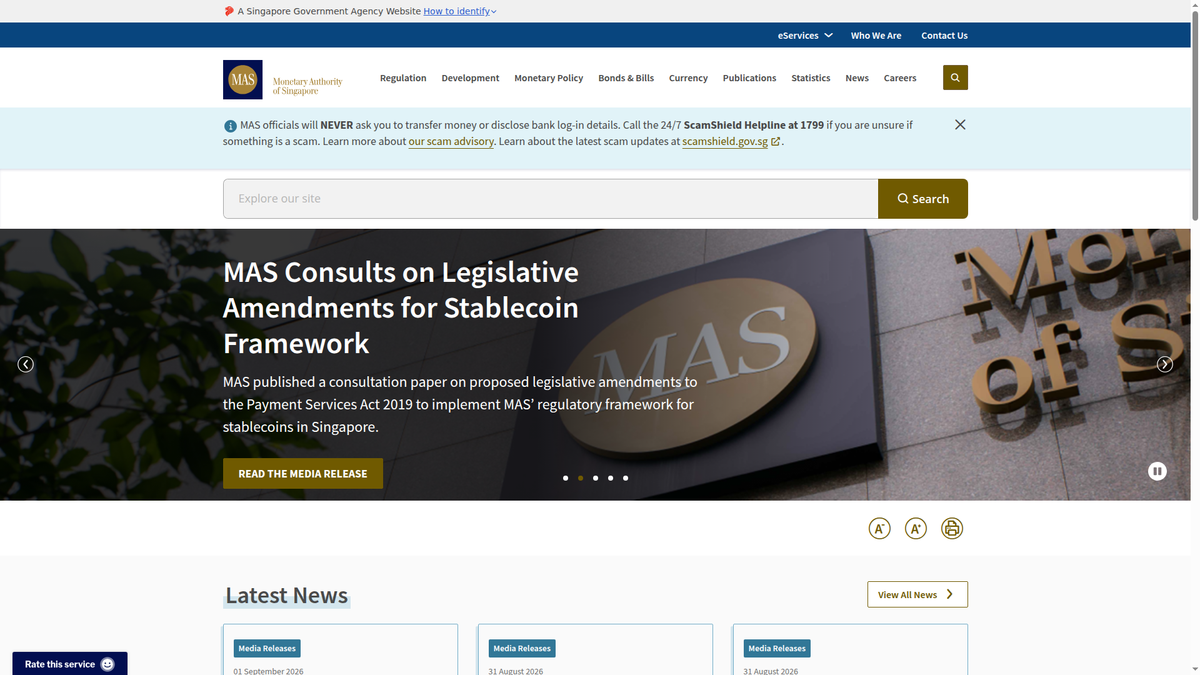
The Monetary Authority of Singapore has committed S$220m, around $173m, over three years to the fourth iteration of its Financial Sector Technology and Innovation scheme, in a bid to keep the city state's fintech ecosystem competitive as private capital retreats.
MAS announced FSTI 4.0 on 31 August. The scheme is built around four goals: anchoring and scaling innovation activity in Singapore, accelerating the development and adoption of financial technologies with an emphasis on frontier technology, developing shared technology infrastructure for the sector, and supporting talent.
Delivery runs through six tracks covering manpower, institution projects, an AI Pathfinder track, infrastructure and platforms, centres of excellence, and the MAS FinTech Awards. A new FinTech Internship Portal at fintechinterns.sg, run by the Singapore FinTech Association, will support a target of 1,000 internship opportunities over the three years, and a GFH Scale-up Grant will be offered to competition finalists.
Public money against a private pullback
The commitment lands days after KPMG's Pulse of Fintech recorded the weakest first half for global private fintech funding outside the US in years, with Asia Pacific down to $4.6bn from $7.1bn in the previous half.
Singapore's own base remains substantial. MAS counts more than 1,800 fintech firms in the country employing close to 10,000 people across technology, data, AI, compliance, cybersecurity and business roles, with fintech investment in Singapore at S$2.9bn in 2025.
The AI Pathfinder track is the most pointed element. Where earlier FSTI rounds spread support across a wide definition of innovation, the emphasis here is on getting AI into production inside financial institutions rather than funding further experimentation, which mirrors what investors have been signalling: capital is moving toward AI businesses with demonstrated deployment rather than pilots.
The competitive read
For banking executives outside Asia, FSTI 4.0 is worth reading as a statement about how financial centres now compete. Singapore is not attempting to substitute for private capital at scale, S$220m over three years would not come close, but it is targeting the two inputs that are hardest to rebuild once lost: shared infrastructure and people.
The contrast with the UK, where fintech investment has fallen to a decade low and no equivalent public commitment has been made, is unlikely to go unnoticed in London.