UK Hands the Bank of England a Secondary Objective on Payments and Digital Money
HM Treasury will give the Bank of England a statutory objective to support innovation in payment systems and digital money, including stablecoins, subordinate to financial stability.
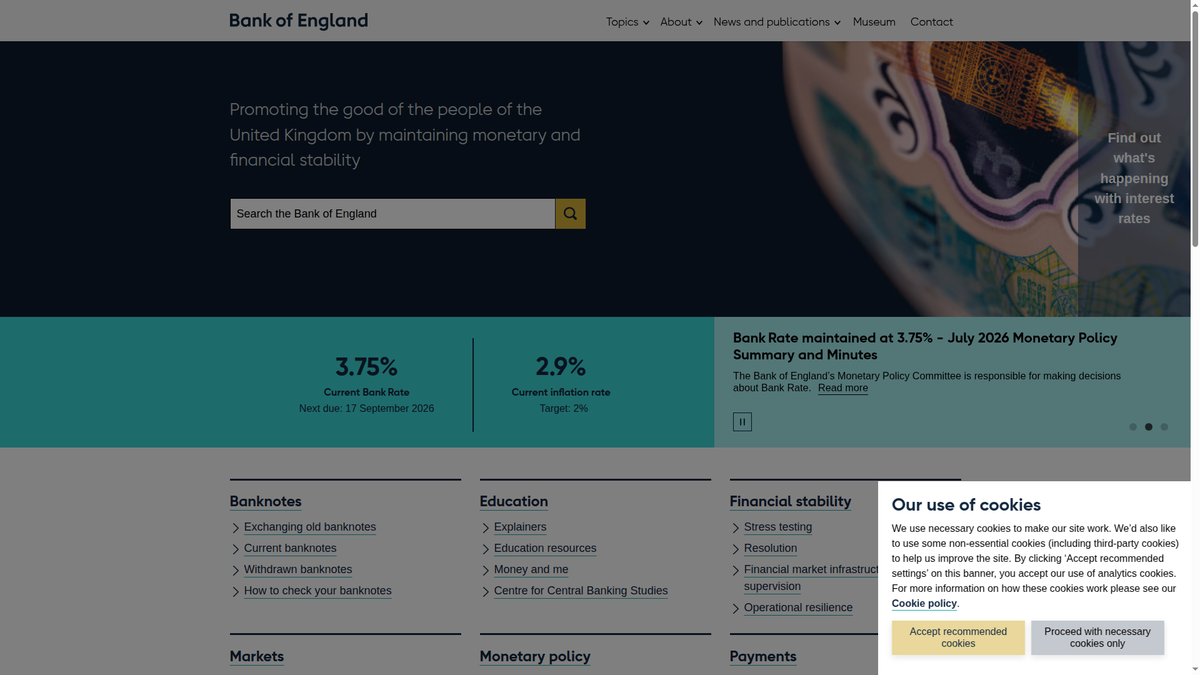
The UK government is to give the Bank of England a new statutory objective to support innovation in payment systems and emerging forms of digital money, including stablecoins, in a change that will be made through amendments to the Financial Services and Markets Bill.
The objective will be secondary. Financial stability remains the Bank's primary duty, and the new mandate will not require the Bank to support innovation where doing so would undermine stability. The Bank will report to Parliament annually on how it is advancing the objective.
HM Treasury announced the proposal on 27 August. The Bill returns to the House of Lords on 7 and 9 September.
"Whilst financial stability will always remain the Bank's primary objective, this secondary objective will support the Bank to continue to drive innovation in payments and digital finance, ensuring that the UK remains a global leader in financial services," said City minister Lucy Rigby.
Sarah Breeden, deputy governor for financial stability at the Bank of England, said: "We welcome today's announcement, which will further boost our work to support innovation in financial services without compromising on financial stability."
Extending an existing model
The mechanism is not new. The Bank already carries a secondary objective to facilitate innovation in its regulation of central counterparties and central securities depositories. The government is extending that same construction to its regulation of payment systems, explicitly including systems that use digital settlement assets such as stablecoins.
The timing places it directly on top of the Bank's live stablecoin work. In June the Bank published its policy statement and draft rules for systemic stablecoins, setting a £40bn issuance cap for each systemic sterling stablecoin and dropping earlier proposals to cap individual holdings after industry objections. Consultation on the draft Code of Practice runs until 22 September, with the Code due to be finalised by the end of the year.
Why it matters
Secondary objectives change the burden of argument rather than the outcome of any single decision. The Bank will not be obliged to approve anything, but it will be obliged to explain annually to Parliament what it has done for innovation, and a supervisor that has to account for its record tends to be a supervisor that moves faster.
For issuers and for banks weighing tokenised deposit programmes, the practical read is that the Code of Practice landing at the end of 2026 will be drafted by a Bank that now has a statutory reason to care about whether the regime is workable, not only whether it is safe.