Airwallex Raises 320 Million Dollars at 11 Billion Dollar Valuation as Agentic Finance Bet Accelerates
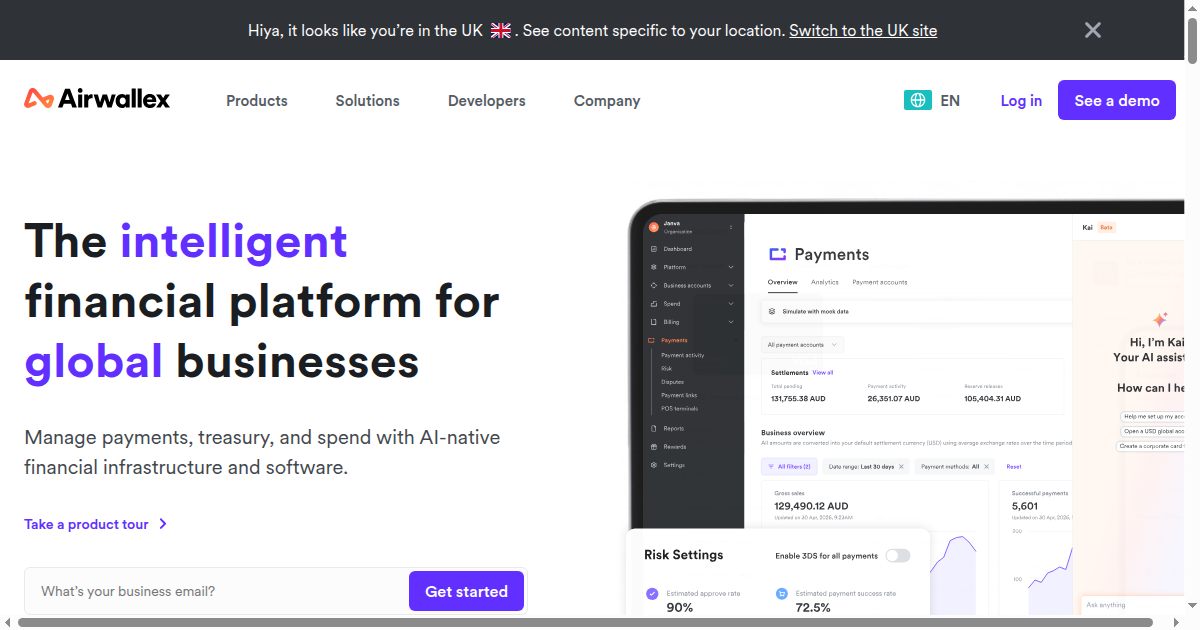
Airwallex has raised 320 million dollars in a Series H round that values the cross-border payments company at 11 billion dollars, a 38 per cent uplift on the 8 billion dollar mark it set only six months earlier. The company announced the round on 25 June, framing it explicitly as a war chest for autonomous finance and agentic commerce rather than a conventional growth top-up.
The round was led by returning investor Addition, with participation from Baillie Gifford, Hummingbird, QED Investors, T. Rowe Price, Hedosophia, Haun Ventures, Amex Ventures and Washington University in St. Louis. That is a notably crossover-heavy register: Baillie Gifford and T. Rowe Price are public-market money, and their willingness to re-price a private payments business upward at this point in the cycle says something about where institutional capital thinks the payments stack is heading.
The proceeds are earmarked for three things: accelerating product development across autonomous finance and agentic commerce, expanding Airwallex's infrastructure and regulatory footprint into new markets, and scaling the engineering teams behind what the company calls its next-generation AI-native financial software. Two products anchor the pitch, T:0, an AI-native autonomous finance platform, and Airi, an agentic consumer wallet. An Agentic Commerce Suite sits alongside them.
The underlying business is doing the heavy lifting for the valuation. As of March 2026, Airwallex reported 1.3 billion dollars in annualised revenue, up 74 per cent year on year, and 287 billion dollars in annualised transaction volume, up more than 120 per cent. More than 90 per cent of revenue now comes from customers using more than one Airwallex product, which is the metric that matters most for a company trying to be infrastructure rather than a single-rail vendor.
Founded in Melbourne in 2015 and now running dual headquarters in Singapore and San Francisco, Airwallex sells global business accounts, multi-currency collections, FX, card issuing and embedded finance to companies that operate across borders. That puts it in direct contention with Stripe on payments infrastructure, Wise on cross-border rails, and Revolut Business and Payoneer on the business-account layer, a competitive set that is converging fast.
"We believe this is the most consequential moment in the history of global finance, and we are building accordingly," said Jack Zhang, co-founder and chief executive of Airwallex. Lee Fixel of Addition put the investment thesis more bluntly: "As AI transforms the competitive landscape, the winners will be the companies building on top of real financial infrastructure, not around it."
The analytical point for banks and incumbent processors is the sequencing. Airwallex spent a decade accumulating licences, local network integrations and settlement rails, unglamorous, capital-intensive plumbing that is genuinely hard to replicate. It is now attempting to convert that regulatory perimeter into a moat around agentic payments, where machine-initiated transactions need programmable, real-time, multi-jurisdiction settlement. If agentic commerce materialises at anything like the scale its backers expect, the licence stack becomes the defensible asset and the AI layer becomes the margin.